Docs / Build
For accredited investors
Coming soon This page describes the planned vault track.
Some strategies need pooled capital and access to a wider range of markets. The planned vault track will let accredited investors fund those strategies in exchange for shares. Their ability to withdraw will depend on the vault's terms.
What is available today
You can currently build for individual investor accounts. Accredited investors use the same account profile and trading limits as everyone else. Accreditation Integrity can review a capital-admission path in your source today, but passing that review does not enable a pooled vault.
The pooled vault, Vault Integrity credential, and wider trading permissions are planned as one track. The rest of this page describes that design, not a feature you can activate in the CLI today.
How the vault will work
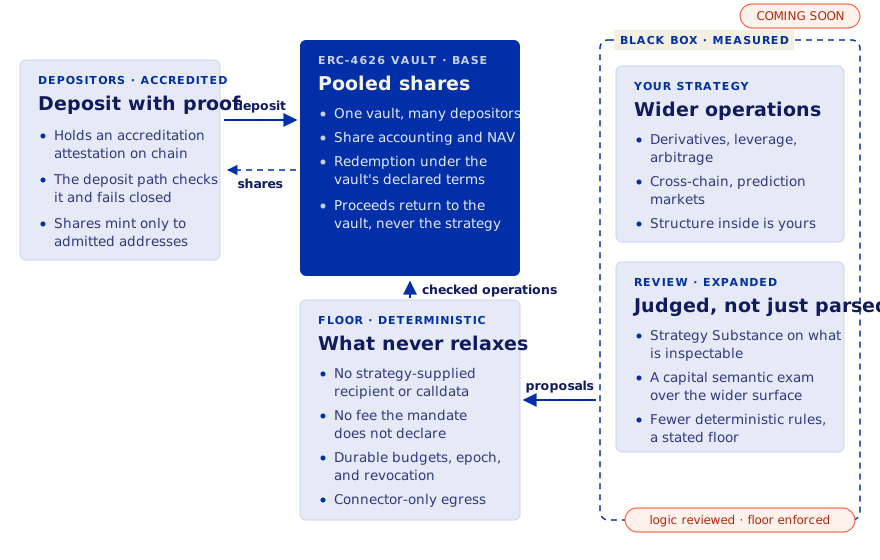
Depositors will put funds into an ERC-4626 vault on Base. ERC-4626 is a standard for tokenized vaults: deposits create shares that represent an investor's portion of the vault's assets. The vault will track those shares and its asset value.
Investors will redeem shares according to the withdrawal terms declared by the vault. They will give up the individual account's independent recovery path. The strategy must state when withdrawals are possible; an unknown withdrawal status cannot be treated as permission to pay out.
Who can deposit
The deposit path will check for a current accreditation attestation on the depositing address. The mandate will name the accepted issuer. Checks happen at deposit time, even if the investor was verified earlier.
An expired, revoked, missing, or unverifiable attestation will block the deposit. Unverified or unsolicited funds will be kept separate and will not increase the capital base used to calculate trading budgets.
This check concerns an address and its attestation. It does not establish that the person controlling the key is the same person who originally completed verification.
What the strategy can do
The planned operation set includes derivatives, leverage, arbitrage across venues, cross-chain positions, and prediction markets, where supported by the vault's adapters. Developers will have more freedom to organize the strategy inside the sandbox.
Some strategies use logic a source review cannot fully inspect. The blackBox behavior declaration identifies that limitation. Strategy Substance must describe what it could actually examine and narrow its claim where the implementation is not inspectable.
Rules every trade must follow
A wider choice of markets will still have mandatory controls:
- Trade proceeds, refunds, and leftover amounts return to the vault.
- The strategy cannot choose an arbitrary recipient, endpoint, or transaction call data.
- Fees must be declared in the mandate. Budgets survive restarts, retries, and redeployments.
- Each transaction checks that trading authority is still current and has not been revoked.
- External requests go through approved connectors.
What the review will cover
The planned Vault Integritycredential will cover deposit eligibility, mandatory on-chain controls, and review of the strategy's logic. Its proposed domain is vault, with TypeScript and Python profiles. It will require the deposit path to pass Accreditation Integrity as well.
The wider range of operations also needs broader review criteria. These include hidden fees in borrowing or funding flows, payments diverted through bridges, undeclared custody dependencies, misleading deposit and return behavior, and tools that can act beyond their stated permissions. That review coverage is still being developed.
Capital Integrity and Vault Integrity will describe different controls. A vault credential should not be read as the individual account's narrower trading policy. It will not guarantee profit, on-demand withdrawals, or recovery outside the vault's terms.